Halle-Neustadt was built as an independent city, starting in 1964. As a chemical workers’ city, it was intended to provide housing and the necessary infrastructure for the employees of the nearby factories. Originally it was planned for approx. 94,000 residents, providing around 35,000 flats in nine residential complexes (so called ‘Wohnkomplexe’). It was and still is the largest large housing estate in Germany outside of the capital Berlin. Halle-Neustadt was incorporated in the city of Halle in 1990.
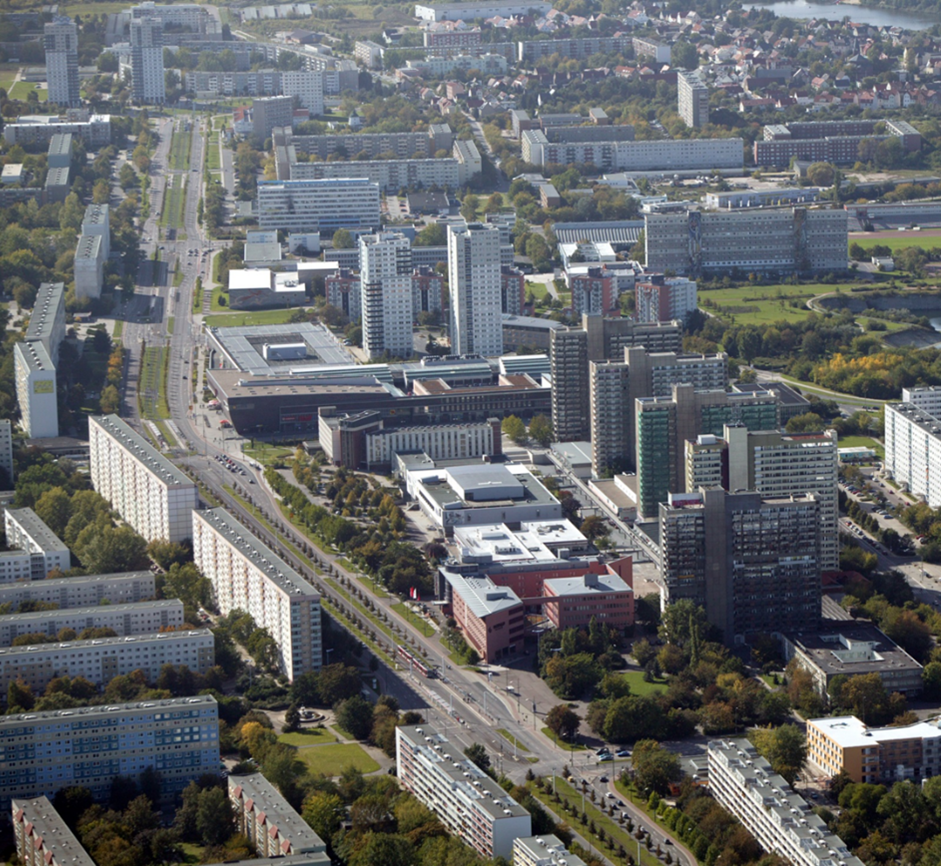
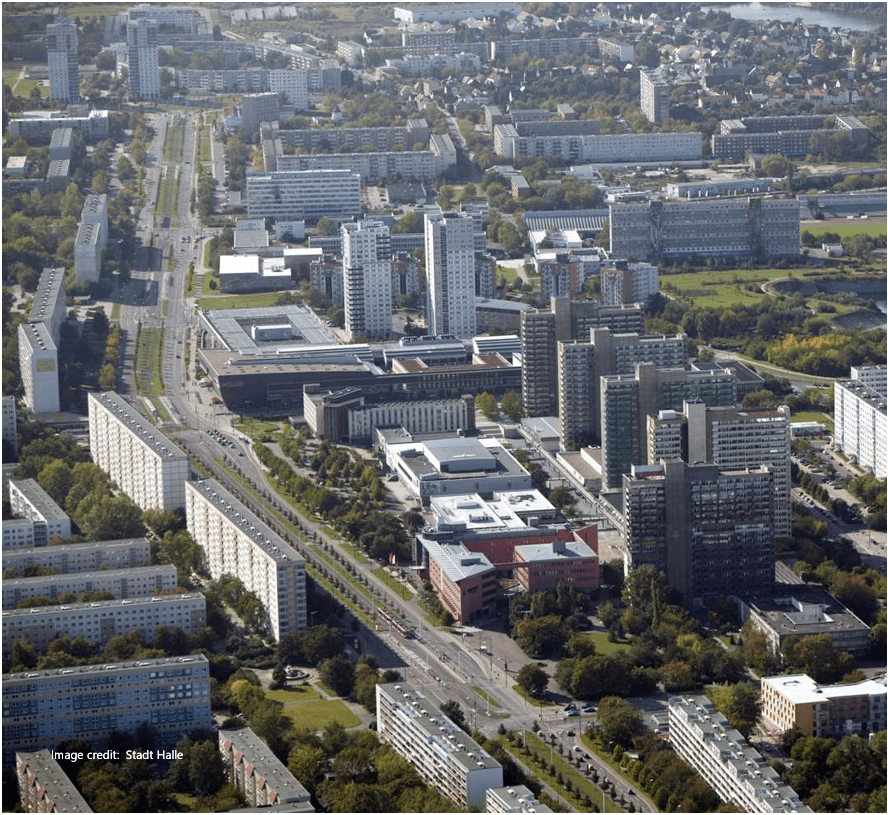
Aerial photo of Halle-Neustadt. Image credit – Stadt Halle
In Halle-Neustadt, classic modernism meets the idea of the ‘socialist city’, mainly planned by the Bauhaus architect Richard Paulick. In the 1960s, the initial four residential complexes and the main parts of the centre were built, which today are considered particularly valuable in terms of urban development. The five 18-storey high-rise blocks in the centre of the estate, which are connected to each other via a pedestrian zone (Neustädter Passage), serve as a landmark of Halle-Neustadt and were intended as a counterpart to the five historical towers of the old town of Halle on the other side of the river. Today they, and some other typical buildings, are listed as building heritage.
As Neustadt has been a formerly independent city, the estate has an own city centre, which is providing a high quantity and diversity of urban amenities and infrastructure facilities (retail, entertainment, authorities, etc.). Additionally, there are also smaller neighbourhood centres in the residential complexes. Despite the aspiration to create a multifunctional district, many important infrastructures were not realised at all or only at a very late stage of development. The estate is connected to the city centre via a main road (‘Magistrale’), two tram lines and a suburban train.
Caused by economically led out-migration and decreasing birth rates, both resulting from the fall of the iron wall and the German reunification, affecting whole East Germany, Halle-Neustadt has lost around half of its population since 1989. Additionally, the image of the large housing estates was getting worse, and people who could effort, moved to refurbished houses in the inner city or newly built suburban areas.
The massive population decline in the 1990s was addressed by a national and federal state funding programme, aiming at demolishing vacant housing to stabilize the market and to avoid deprived areas (‘Stadtumbau Ost’ – national urban redevelopment programme).
The original idea, to focus on the deconstruction at the fringe and to stabilize the inner areas, could only be implemented to a limited extent. In the 1990s a larger amount of the formerly municipal owned housing stock was sold to large private enterprises. The diverse ownership structures (municipal housing association, municipal housing associations, real estate companies) limit the opportunities to guide and manage the overall development of the estate. So, perforation of the building structure took place by selective demolition, infrastructure facilities were demolished and selective refurbishment led to a very heterogeneous situation of the building stock. In some parts, the municipality lost its power to guide urban development. Nevertheless, the efforts helped to continuously reduce the number of vacant flats. Parallel, funding was spent to improve the public space, green spaces and the infrastructure provision.
Parallel to shrinkage and ageing, segregation took and takes place. Due to affordable rents, low-income households and people being dependent on state subsidies move to the estate. The estate is characterized by the highest unemployment rate, childhood poverty rate and lowest income compared to the whole city. Due to international migration, a growing number of refugees settled there, since vacant and affordable flats are available. Following population numbers are growing again, while in particular social and educational infrastructure is insufficient. These recent dynamics mean also new requirements for housing, public spaces, and infrastructure. The diversification, marginalization, disparities and also growth mean fundamental challenges for urban authorities to develop Halle-Neustadt as an attractive and valuable part of the city.
The strategic aim for Halle-Neustadt is to prioritise the core areas as high-quality and attractive neighbourhoods. Furthermore, the city is continuously developing and shaping sustainable transport systems, in particular by promoting an environmentally friendly transport by increasing the share of public transport, cycling and walking. The aim is to ensure just mobility options for all population groups.
Sources:
Integriertes Stadtentwicklungskonzept Halle 2025; Strukturkonzept Statteilzentrum Neustadt [https://halle.de/leben-in-halle/stadtentwicklung/raeumliche-konzepte]
StadtumMig-Projektteam (Hrsg.) (2023): Vom Stadtumbauschwerpunkt zum Einwanderungsquartier. Herausforderungen und Perspektiven für ostdeutsche Großwohnsiedlungen. DOI: 10.18452/25294
.