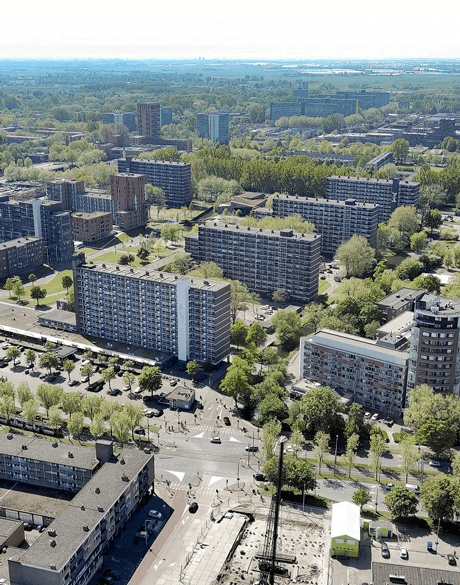
Delft West is a post-war urban district in the city of Delft, located in the western Netherlands. Originally developed in the 1960s and 1970s, the area reflects the modernist urban planning ideals of its time—car-oriented layouts, separation of functions, and expansive infrastructure. Today, it comprises several neighborhoods including Buitenhof and Voorhof, and is home to a diverse, dynamic population facing multiple social and spatial challenges.
The urban fabric of Delft West is characterized by large housing blocks, open green spaces, and infrastructure built for high vehicular mobility. The district was planned with wide roads and clear zoning divisions, which resulted in the isolation of housing from commercial and social services. This has led to functional fragmentation and a lack of vibrant public spaces.
Mobility infrastructure in Delft West includes well-established cycling paths and connections to the city’s tram and bus networks, making the area accessible to the inner city and regional destinations. However, despite the good physical connectivity, there are issues of social disconnection and declining use of local amenities.
In recent years, urban redevelopment efforts have aimed to shift from a car-dominated structure to a people-first mobility model. Strategic plans focus on improving walkability, expanding the cycling network, and enhancing pedestrian safety, while also repurposing public spaces and underused infrastructure to support more inclusive and sustainable forms of mobility.
Key initiatives include the Kop van de Buitenhof project—a long-term transformation plan to integrate social, economic, and environmental upgrades. The area is undergoing spatial and functional renewal through participatory masterplanning, which emphasizes healthy living environments, functional mixing (housing, education, healthcare), and improved public spaces.
Challenges for Urban Planning:
- Adapting car-oriented layouts to support active and sustainable mobility.
- Revitalizing social and commercial amenities to meet changing demographics.
- Enhancing public space usability and liveliness.
- Managing social diversity and inclusion in planning processes.
- Ensuring efficient maintenance and long-term spatial quality.
Delft West serves as a critical testbed within the 15minESTATES project for exploring how proximity-based planning and co-creative processes can support just and sustainable mobility in large-scale residential districts.